• Charity Center Join us on the 24th May
  • Charity Center Care, educate, grow
  • Charity Center Give the gift of education sponsor a child today!
  • Charity Center Join the community and make a difference

Charity Center

Greetings from ‘all shades-of-green, very soggy’ Katoke
PDF Print Email
Written by Katoke
Friday, 17 May 2013 00:00

A letter from Marilyn Moir, in Tanzania.

Marilyn is the student welfare officer at Katoke-Lweru Secondary School, Tanzania. She and her husband Sid, headmaster, and their adult daughter Anna, sponsorship coordinator, are in their fifth year of service.

Greetings from ‘all shades-of-green, very soggy’ Katoke. We are nearing the end of a very wet season and while most days start with a drenching deluge of rain - which might remain unremittingly intense for up to five hours – the days will usually end in brilliant sunshine. While the rain is necessary for crop production (especially maize and beans) it causes much suffering. Poverty means shelter is often very flimsy (wattle and daub with grass roofs) and many houses get washed away, or collapse under the power of the deluge.

One of our students, Nelson, who is also an evangelist and father of three children, went to visit his family after heavy rain, to find his house collapsed and his mother and children in hospital. Imagine his joy, and ours, when we were able to console him with God’s provision, because a very generous donation had come through from Australia. He was able to rebuild a much sturdier, although tiny, house made from baked mud bricks with iron-sheet roof. Thank you to everyone who enables me, through the welfare fund, to offer this kind of assistance. Now Nelson will be able to continue his studies and future work, knowing his family is secure; not just in terms of shelter, but most of all in God’s care.

This year has been thankfully, so far, without the high dramas of last year, but has been  increasingly busy. Sid is usually down at school by 5am and both of us rarely get home before 6:30pm, or later. Evenings are often interrupted with dormitory problems, such as sickness – we are really exhausted. The workload has been enormous, especially because our sponsored Form 4 students from 2012 have been returning on a daily basis for assistance.

So, here we are, breaking new ground as we try to research availability and quality of colleges to which we can send Form 4 leavers, so they have vocational training. Some have already gone to commence training,  as medical lab assistants, in nursing careers, business studies, accountancy, welding, carpentry, masonry, secretarial, computer-related work and primary or nursery teaching. Each person requires much time, as we research possibilities, cost and availability of sponsors. We are so grateful to all who were so willing, when asked, to continue to help  sponsored students, so that they can be trained to enter the workforce. I wish you could be present when word comes through that sponsorship will continue, or is available. So many are orphans and, without this help, would be doomed to remain in their village, where life is lived at a subsistence level, and where sickness and crop failure and vagaries of weather leave them so vulnerable. Special thanks to Lee [sponsorship co-ordinator] for her efforts.

Recently, another evangelist among our students, Emmanuel, himself an orphan, returned from his village with a request to bring a young boy, Byamungu, to school. Emmanuel had known this boy when he was quite small and met up with him again. Byamungu was without family, or home, simply wandering from place to place. He had also been forced by circumstances to leave his education. We decided, after he did our entrance exam, to accept him. Emmanuel was overjoyed, as was Byamungu (he is still traumatised and  malnourished). Emmanuel’s eyes filled with tears (me too!) as he thanked me and said: “Mrs. Moir I often think ‘where would I be, and what would my life have been without this school?’ When I finish I want to help more boys like Byamungu.” I replied “Emmanuel, perhaps you will be the George Mueller [founder of orphanages] of Africa,” and he said “yes, and Byamungu will be my first orphan. My home will be his home, when I finish school, and he will be the first of many.”

We usually praise God when we hear such responses from students because it is our constant prayer that, just as we have come to serve them that they will catch the vision and go on to serve in the same way. It was a great joy too, through your kind donations, to be able to supply Byamungu with a mattress, blankets, socks, underwear, shoes, etc. He has health issues, but I’m sure with some TLC he will quickly improve and settle happily into the life of our school. He will need a sponsor, as do so many others do, so please continue to spread the word about our school.

Rosemary Hildephonce, previously one of our office assistants and a deserted parent withfour young children, recently contacted me. She was suffering from intense pain, radiating from hip to ankle. Two hospitals wanted to amputate and so I sent her money (from welfare) so that she could she could travel and be assessed by Dr. Rogation at the close-by hospital at Izigo. She had previously been there, with the same complaint. Dr Rogation had diagnosed cellulitis and was confident a prolonged course of antibiotics would cure the infection. So Rosemary has left three of her children and come back with her youngest to stay at Dr. Rogation’s little hospital. It is quite primitive, but she is responding to treatment. To save her money I have been taking food from our own table each night, up to the hospital, which has added to the time I arrive home. Yesterday, Rosemary moved into a little rented room so she will cook for herself until treatment finishes. She wants to work with us again, but this time leave the children in care up at the plateau, and travel back there each weekend. I would love to have Rosemary back, as she was so reliable, a self-starter and has good English.

Liberatus, another student, came to see me to show a nasty gum infection developing (along with two broken front teeth) following an accident during PE. He had suffered in silence because he couldn’t afford treatment. So again, I was able to draw on welfare money to send him to a dentist in Bukoba; the total cost will be around 80,000/- about $50, a relatively small amount to avoid what could become a huge problem.

These are just a few examples of how welfare money is used. My welfare book is full of such stories, assisting beyond the school, as well as inside, wherever the need is presented.

Please pray for our students’ health: UTI, malaria, typhoid, skin infections, stomach ulcers, worms, chest infections, influenza (Africans become very. sick with flu), eye problems often requiring spectacles; these problems are always present. We are always kept busy, sending them off to the dispensary, local hospitals or caring for them in sick bay.

It is amazing that our own health holds out and we really can say that daily, God renews our strength in spite of incessant demands. Please pray that God will protect our whole site. Across Tanzania there is increasing concern about tension developing between Moslems and Christians. This country has always enjoyed peace internally, since independence, and recent outbreaks of violence against Christians and churches have been a worrying development.

We always pray for God’s protection over our guards and site each night. I am always amused to see our cool African cat, Mufasa, who is always at the heel of our guards. This morning we were awakened by the guards to hand over keys, and sure enough, there was the third, feline, guard accompanying them, like a dog at heel.

On Tuesday Paul [Hoffmans] leaves after his great help as accountant / bursar and we are looking forward to the arrival of Rowena and Peter Bragg, in early June, who have committed to at least two years here. Thank you again to every one of you who have been supporting us in so many ways. Our work could not continue without your prayers, generosity and encouragement.

A post-script, following a trip to Bukoba, which illustrates the poverty trap. It filled me with a yearning to see people like Richard experience God’s love.

Richard is about 17, and he approached me because his job is to collect a parking fee. He was disappointed to see that we had already bought our ticket. “Please come and find me next time,” he pleaded. Seeing that he had reasonable English, I asked his name; “Richard Medad”. Sensing my interest, he poured out his story. Yes, he had completed Form 4 but: “I am an orphan, and have only a younger brother. I am responsible for him, and I’m trying to pay for his schooling.” Richard’s salary, by the way, is meagre - on a good day, maybe 3000/- [$2]. His future seems so bleak. “If my parents were here, they could help,” he said sadly. ‘Could I offer him a job?’ he asked.

Orphans are so vulnerable ... I felt very sad as I said ‘goodbye’. I will maintain my connection with Richard and pray that God will show me a way to assist him.

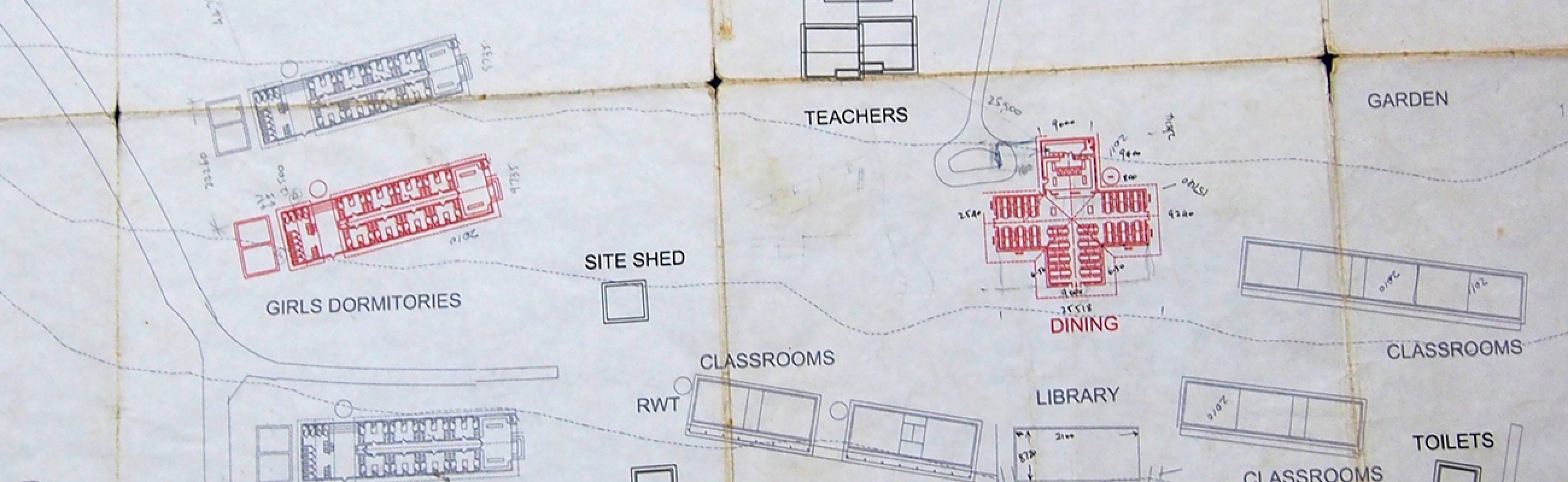
The Welfare Fund  is administered by Marilyn Moir for medical and other emergencies. It is one of several programs of the Katoke Trust for Overseas Aid that are meeting human need by providing education, better health and cash crop extension.  Funding  is provided by Australian supporters through tax deductible contributions.  A major current project of the Katoke Trust is establishing a life-changing secondary school in this remote rural centre in north west Tanzania. It is in its fifth year of operation, with 326 students.


Last Updated on Wednesday, 22 May 2013 19:02
 
KLSS Results in the 2012 National Exams
PDF Print Email
Written by Katoke
Friday, 01 March 2013 12:00

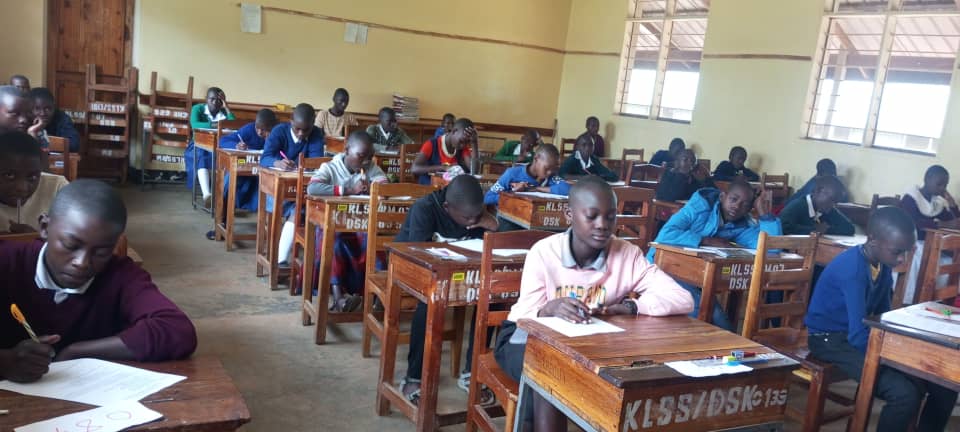
Katoke-Lweru Secondary School (KLSS) performed well in national form 4 (year 10) exams. The students placed 21st out of 201 schools in the region and were in the top 15% nationwide. Achievement in some individual subjects was very meritorious; For example, in the Region, the school was placed 18th out of 218 in Maths and 22nd in English. Well done KLSS!

Despite these good achievements Headmaster Sid Moir sees there is scope for improvement. There are five divisions of results in the Tanzanian National exams; Divisions 1 to 4 are a pass, division 5 is a failure. Of the 125 students from KLSS who sat the exam, 74 passed and 51 failed. Three gained Division 2, 5 gained Division 3 and 66 gained Division 4. Places in Tanzanian senior schools (Forms 5 and 6) are very limited and results seem to be managed according to the places. Usually the government will let only those who gain Div 1 to 3 go on to government senior (high) schools. HM Sid Moir was disappointed KLSS did not have more in these categories but, with the bottleneck to Form 5, the results seem carefully determined to fit the numbers who can be given places in government schools. There are just not enough places to allow capable students who pass to go on and so most passes are Division 4. KLSS is planning to begin its senior classes in 2014 to help meet this need.


Last Updated on Friday, 01 March 2013 12:40
 
Together we built a classroom
PDF Print Email
Written by Katoke
Wednesday, 14 November 2012 00:00

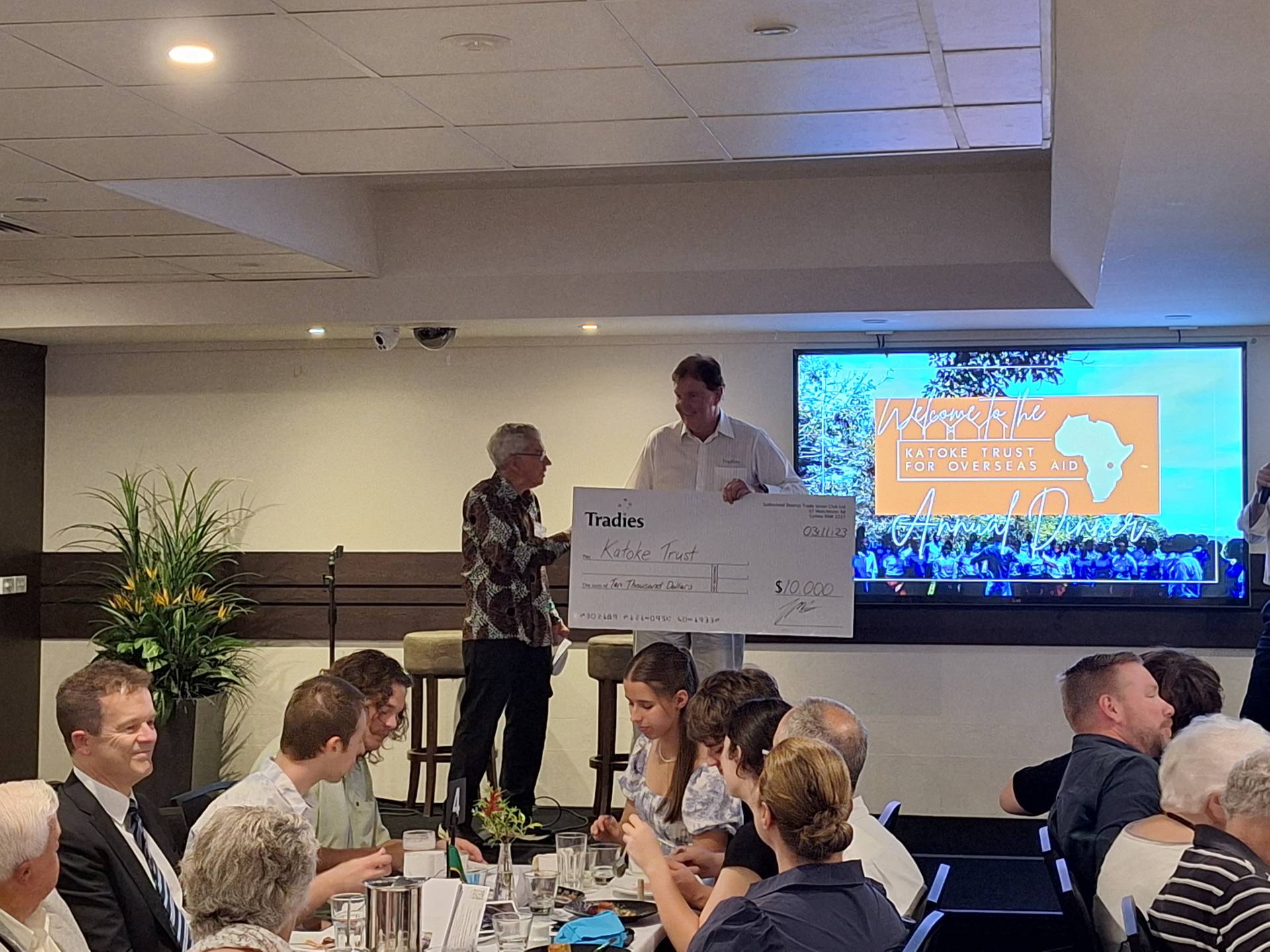
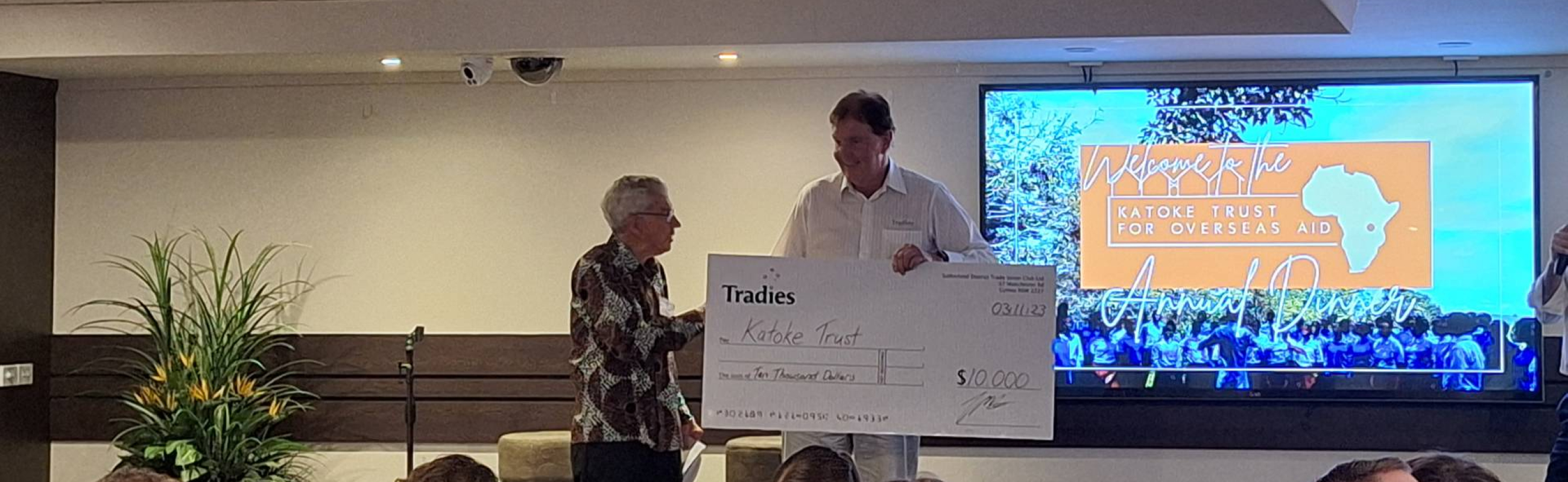
We had a marvellous night on Friday at our 14th Annual Katoke Trust Benefit Dinner. Together we built a classroom, together we made a difference. Thank you for letting us know what you thought of this year’s event. We have included some of your feedback below.

'A fantastic night. Well done'

'Incredible result – New classroom – Congratulations'

'Marilyn gave a tremendous talk'

'Highlight was Sarah on the violin'

'A HUGE Bouquet to Amanda and the team. 110 out of 100.'

This year the Katoke Trust Annual Benefit Dinner raised over $35,000 - an incredible result! There are also nine students who will be able to attend school next year thanks to the generosity of their new sponsors. I look forward to updating you on the building progress of the classroom over the next 12 months.

On behalf of the Katoke Trust for Overseas Aid and the people of Katoke, I would like to say thank you for your generosity and ongoing support.

Photo's from the night can be found here


Last Updated on Wednesday, 14 November 2012 12:42
 
Samuel Habimana: Sorrow and thanks
PDF Print Email
Written by Katoke
Sunday, 06 January 2013 00:00

With great sorrow and thankfulness I learnt that Pastor Samuel Habimana departed to be with the Lord last Friday evening. Canon Habimana has been my co-worker and the initiator of many projects at Katoke where he served as tutor at the Katoke Teachers College and as pastor of the church with faithfulness and distinction since 1971. He was my friend and advisor as we developed the anti-poverty program of the Katoke Trust with its three themes; education, health and agriculture. He was the Chair of the committee that built the Dispensary at Katoke with its six bed ward and clinical program. The very effective malaria and AIDS prevention programs were conducted under his oversight. He taught English to pastors and in the eight year school improvement program for the 21 primary schools surrounding Katoke and he was the co-founder of the Katoke-Lweru Secondary School, being the Chair of the Tanzanian committee that brought that school into being. He has run an English College, taught and pastored students and staff at KLSS and has been the close advisor to the Headmaster in establishing the program of the school.

When he visited Sydney in 2011, he made a great impact as he spoke to bible study groups, schools, churches and was keynote speaker at the Katoke Trust Annual Dinner. Australians saw first hand the strength of of his Christian character and many more began to support the Trust by donations and student sponsorships following his visit.

We thank God for his life and his wonderful example as a leader at Katoke and throughout East Africa. We send our love to Mama Haleluya and his family and we pray that they will know God’s peace and comfort in their bereavement.

It has been a privilege and an honour to have known and worked with Pastor Habimana. He leaves us with great inspiration to carry forward the life-giving message of the gospel and the vision of the Katoke Trust.
Bwana Yesu asifiwe.

Professor Alan Watson
President, The Katoke Trust


Last Updated on Monday, 07 January 2013 20:19
 
Community Health Education Programs Make Great Progress
PDF Print Email
Written by Katoke
Wednesday, 16 May 2012 21:54

Community Health Education Programs Make Great Progress

The Katoke Trust has received a heart-warming letter of thanks from the District Medical Officer in Muleba (near Katoke) for the work done both in malaria prevention and dental care. “On behalf of the community I would like to express my thanks…to Prof. Alan Watson, the President of the Katoke Trust for his tireless struggles in soliciting funds”  the leader of the Malaria Prevention Project, Ludovick Lweikila has written.

Malaria Prevention

"According to community leaders, malaria is the greatest killer of young children in Tanzania, and in Africa at large, and for those children who survive it has been responsible in a large part for hindering their intellectual and physical development. ">Since the project began ten years ago a vigorous education program has been conducted and over 20,000 nets  distributed in five local villages, through schools and dispensaries. Village leaders were taught about the causes of malaria and the impregnation of nets with insecticide  tablets, so they could pass this information on to their communities. They were instructed to put emphasise on pregnant women and children under five. ">Following the success of this program, a further four villages (some 4000 people each) have pleaded to be involved in the program, which will cost about $8,000 per village or $2 per person. If you would like to support the Katoke Trust in this endeavour, you can click here to donate.  A school or group could adopt a village.

Tooth Aid

The dental health education program has also been extremely effective, with reduced complaints of tooth illnesses and decay. “The tooth health education Project has been one of our many achievements," the project manager commented.  "We thank God that complaints we used to hear in schools and villages, particularly to [concerning] children have been lessened …  one parent told me that he got his tooth health education from his primary-school attending child.”

Last Updated on Wednesday, 16 May 2012 22:07
 
<< Start < Prev 1 2 Next > End >>
Page 1 of 2